Continuing the series of student misconceptions that have been reported by the physics education research community, this post is about work and energy.
Energy is an abstract concept. It cannot be seen, but the effect can be observed in everyday life. It is an idea that is readily accepted when one is first introduced to it, but it can be confusing to some people when you go into the details.
Work is defined as . In the secondary school level, it is the product of force and the displacement in the direction of the force. Its physical meaning is the conversion of energy from one form to another. For example, if a person exerts a force of 10 N on a block and move it for 1 m, then the force does work of 10 J on the block. This 10 J of energy came from the person in the form of chemical energy. It is being converted to the kinetic energy of the block.
Research articles I read:
- Student Misconceptions of Work and Energy in Engineering Dynamics by Liu and Fang
- Student ability to apply the concepts of work and energy to extended systems by Lindsey, Heron, and Shaffer
- Student understanding of energy: Difficulties related to systems by Lindsey, Heron, and Shaffer
Student Misconceptions of Work and Energy in Engineering Dynamics
This paper is comprehensive. It compiles what previous researchers have reported and what they found in their engineering students. Liu and Fang listed 23 student misconceptions in work and energy. The authors categorized the misconceptions into those two main ideas, energy and work. Below is a screenshot of the misconceptions listed in the paper.
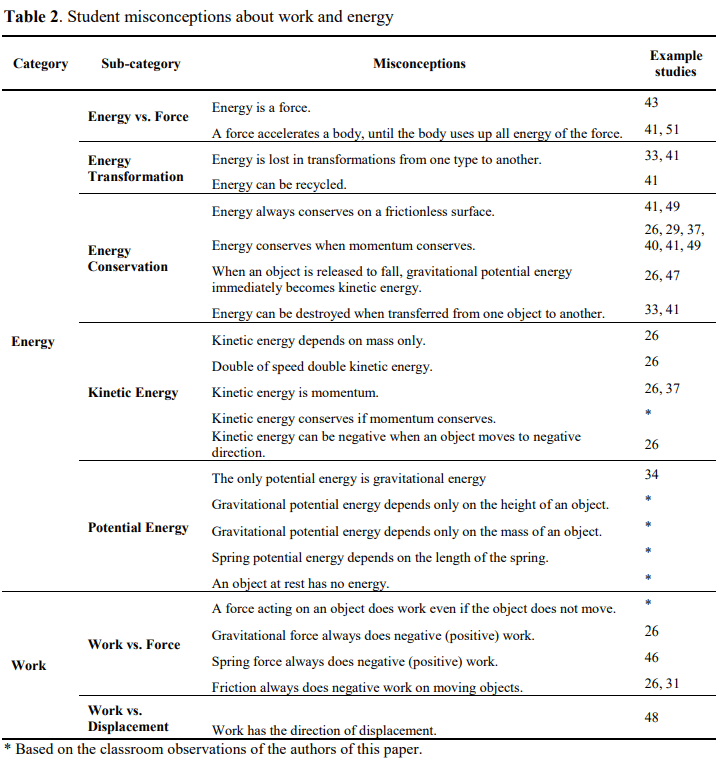
Some misconceptions listed above are related to the definitions. For example, under the sub-section Kinetic Energy, one of the listed ones is “Double of speed double kinetic energy.” From the definition of kinetic energy
,
the kinetic energy is directly proportional to . So, if students follow the definition properly, then they should say that the kinetic energy would quadruple when the speed is doubled. Other aspects of misconceptions involves the application of the relevant concepts, for example, the misconception “an object at rest has no energy” does not include the existence of potential energy.
Student ability to apply the concepts of work and energy to extended systems
The authors investigated student ability to apply work-energy theorem to extended systems. The work-energy theorem states that the work done on a particle by external force is the change in kinetic energy of the particle.
For an extended system consists of more than one particle, the net work done on the system is the sum of all individual works, which corresponds to the change in total kinetic energy of the system.
This paper reported the following student difficulties:
- Belief that the energy of any system is constant: Failure to interpret the statement “energy is conserved” correctly.
- Reasoning based on changes in kinetic and potential energies: Failure to treat the work-energy relation as a statement of cause and effect.
- Overgeneralization of relations between work and energy: Tendency to associate work with a change in either kinetic or potential energy rather than in the total energy
- Tendency to treat the sign of the work as depending on the coordinate system
- Failure to consider the displacement of the point at which the force is applied
- Belief that the net work depends on the net force
Student understanding of energy: Difficulties related to systems
This paper reported the results of investigating student ability to identify systems of interest to solve problems related work and energy. A good choice of system of interest can make solving energy-related problems easier. Here are the student difficulties reported in this paper.
- Failure to recognize that an energy analysis depends on the choice of system
- Tendency to associate potential energy with a single (point-like) object rather than with a collection of objects
- Assumption that the energy of any system is constant
- Tendency to double-count work and energy terms
- Failure to recognize that any group of objects can be treated as a system
My personal opinion for teachers
The participants in those studies are undergraduates. The prevalence of such difficulties among the undergraduates implies that some difficulties could be present when students learn physics in high school or pre-university level.
I always like to emphasize definitions when I interact with students. The reason is that if students are not clear with the definitions, there is no common ground. Teachers can remind students about the definitions from time to time, but in the end, students still need to put in the work to make sure they know the definitions.
Meaningful exercises and activities can be designed to help students learn energy concepts better. For example, one can try out the PheT simulations or Algodoo.
My personal opinion for students
If you are a high school student who happens to reach till this end, I thank you for that. My personal opinion is that you need to be clear with the definitions. Knowing the definitions is really the first step. Then you need to test how you apply them by doing questions. Those questions and exercises are meant to help you familiarize with the ideas. There is no shortcut in getting better in physics. I started out with a C grade when I first learned physics at 15 years old, and I think you can also get better in physics.
That’s all from me. Let me know if you have any comments and suggestions. Hope you find my post useful!
 Chang Physics Class
One thought on “Student misconceptions about work and energy”