This topic is more related to the learning of physics in secondary school in Malaysia and Singapore.
I had a chance to look at the physics syllabus at the SPM level, Singapore GCE O level, and iGCSE Cambridge.
In the iGCSE Cambridge physics syllabus, students are introduced distance-time graph. In the SPM and GCE O level physics syllabus, students are introduced displacement-time graph. For those who continue to do physics at the university level, they will see position-time graph.
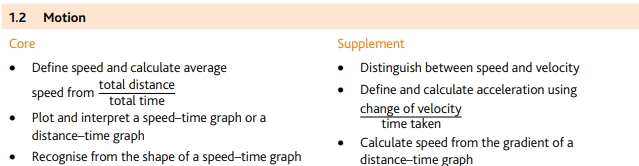
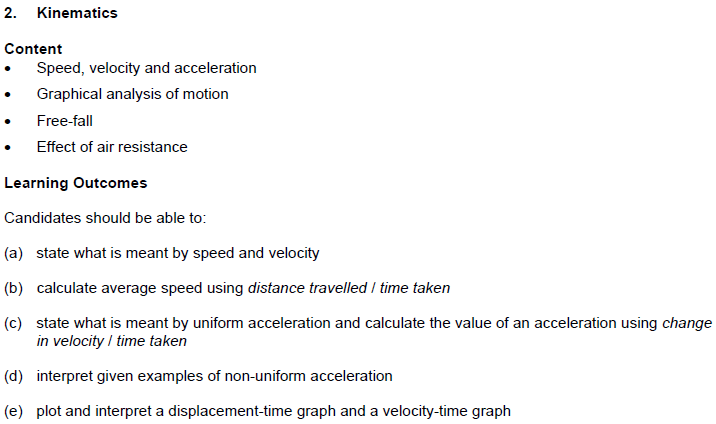
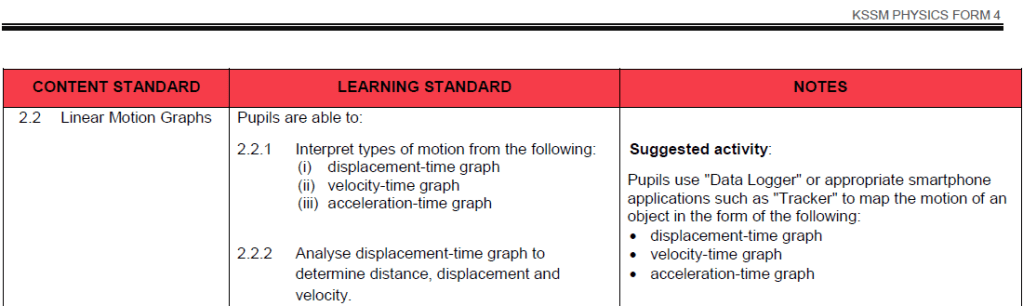
These graphical representations are meant to represent the motion of a point particle.
Why is there a difference in the names?
Before answering that question, let me define the terms: distance, displacement, and position.
Distance: Length in space between two points
Displacement: Change in position
Position: Location of a point relative to an origin, in other
My stand on this issue: Students should use the term position-time graph in describing the motion of a point particle. People who write the syllabus should use the proper name.
Here are my reasons:
Number 1: Distance traveled is always increasing, but a particle can be at a larger position initially and then at a smaller position at a later time.
As defined previously, distance is the length between two points. When it comes to describe motion, the “distance” in the distance-time graph would describe the distance traveled by a particle. However, it can be different from the position or displacement of the particle. Furthermore, the distance traveled by an object is always increasing by definition. For example, a ball that is thrown up and then experiences free fall will have different distance-time and position-time graphs as shown below.
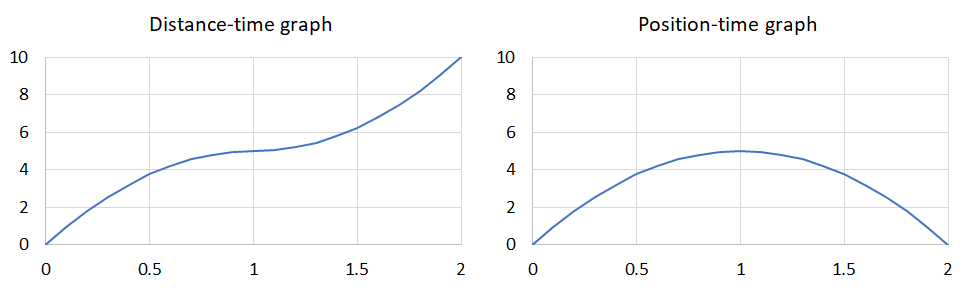
The graphs show the limitations of distance-time graph. It can only describe an object that is moving in one direction correctly, but not motion that involves a change in direction. It also does not inform people about the direction of motion.
Number 2: The term “displacement” in the displacement-time graph stated in the syllabus actually meant “position”.
The word “displacement” in the syllabus actually means displacement from the origin, which is the same as the meaning of “position.”
I understand that students knew about “distance” before learning physics. I also know students can get confused about “distance” and “displacement.” If the term “position” is introduced, students may get confused further.
In terms of observing the motion of a particle, one starts by recording the position of the object relative to a reference point. That point can be any convenient point, such as the starting point of the motion, or where the detector is.
The idea of position is like recording the coordinate on a graph. It is not something new to students who had experienced with graphs. (To be honest, students also get confused in graphs.)
Displacement means change in position. One can ask the displacement of the object between any two instances in time. It does not have to be between the starting time to the time of interest. This definition of displacement is being used in the definition of average velocity and instantaneous velocity as well.
My stand
Curriculum writers may think it is better to reduce cognitive load, but it does not necessarily help those students who will be studying physics in the undergraduate years. The distinction is small in the beginning, but the ingrained idea of displacement without knowing position can confuse the upcoming physics majors and engineering students.
When I was a physics TA back in the NUS, one engineering student asked me to clarify what the lecturer did with displacement during lecture. At that time, I was not aware of such differences and thought that the lecturer was not doing the right thing. After more years of teaching, I started to wonder why the term “position” was not used in the secondary school physics teaching. Is the idea of “position” that hard to understand?
That said, I still use distance-time graph and displacement-time graph when I tutor secondary school physics students, because that’s what students are going to see during exams.
I have not seen the effect of teaching of the term “position” in pre-university years on the learning of physics at the university level. It is possible that there is no difference after all. In that case, then I would prefer to teach the correct terminology. It is true that students will get confused with displacement, but they will get confused anyway. Beginners will always get confused, it is through time and deliberate practice that helps them get better.
 Chang Physics Class